Cold-Pressed vs Heat-Dried Tart Cherry: Why Processing Matters
By Amanda Bryne9 min read
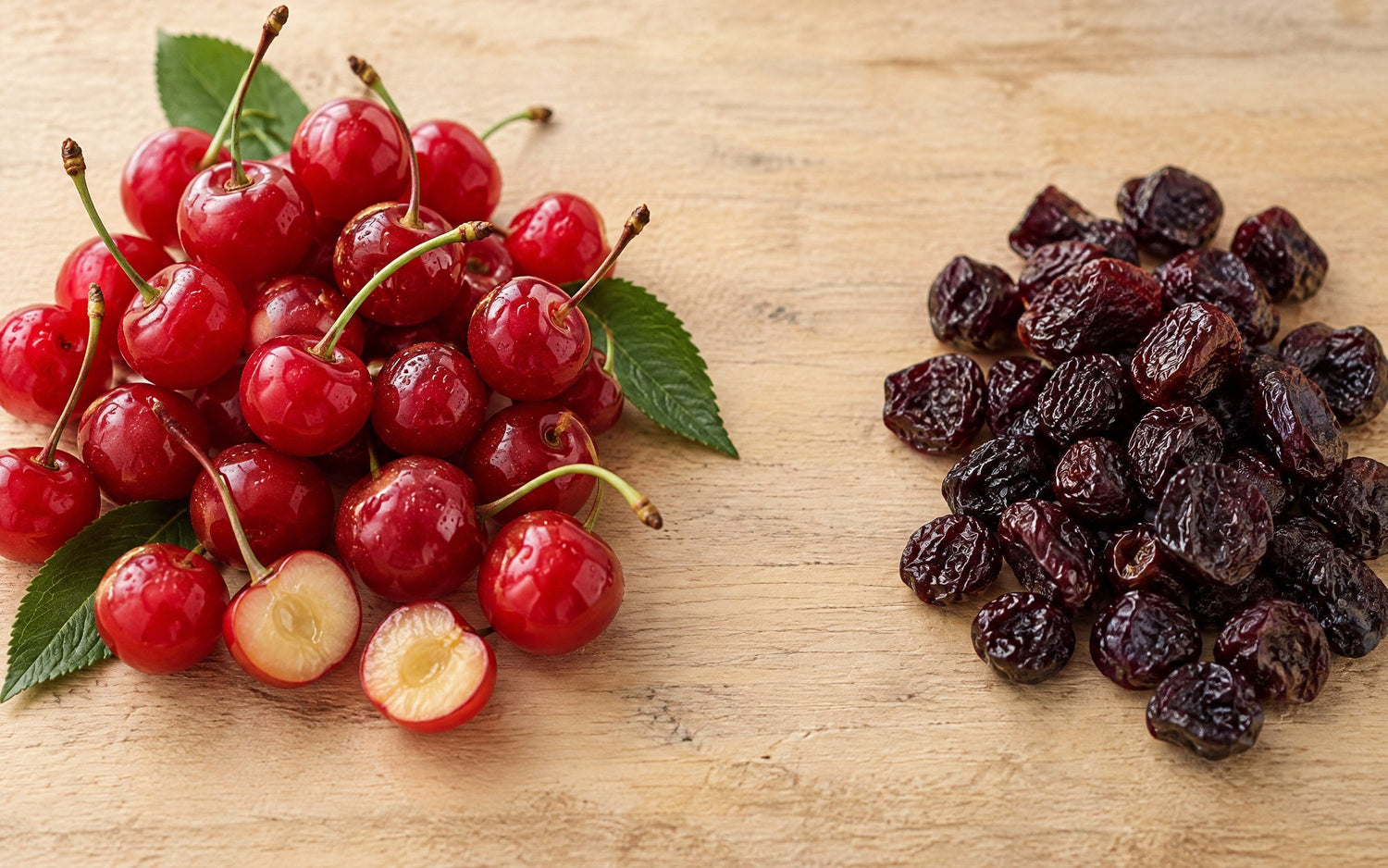
Heat breaks down anthocyanins, the red pigments in tart cherry that most of the research points to. Cold-pressed tart cherry is pressed and concentrated without cooking, so more of those pigments survive into the capsule. Heat-dried tart cherry is cooked down or dried in hot air, and the food science shows a measurable share of the anthocyanins is lost along the way.
That is the short version. The longer version is more useful, because "cold-pressed" and "heat-dried" are not the only two ways to turn a cherry into a powder, and the losses depend on how hot and how long.
This article walks through what happens to a Montmorency cherry between the orchard and the bottle, what the published numbers on heat and anthocyanins look like, and what to check on a label.
Key studies at a glance
| Study | What was tested | Form and dose | How long | What the researchers found |
|---|---|---|---|---|
| Szalóki-Dorkó et al. 2015, Food Technology and Biotechnology | Heat and anthocyanins in sour cherry juice | Juice from 2 sour cherry varieties held at 70, 80 and 90 °C | 4 hours | Anthocyanins fell 18 to 19 % at 70 °C, 29 % at 80 °C and 38 to 46 % at 90 °C |
| Wojdyło et al. 2014, Food and Bioprocess Technology | Drying methods for sour cherries | Sour cherries dried in hot air at 50, 60 and 70 °C vs vacuum-microwave vs freeze-dried | Until dry (lab study) | Hotter air meant fewer phenolics, lower antioxidant activity and duller color, in line with anthocyanin content |
|
Akcicek et al. 2023, ACS Omega PMID: 37970003 |
Hot-air drying vs freeze-drying of a similar berry | Blueberries dried in hot air at 50 °C vs freeze-dried | Hot air: 1,290 minutes (about 21 hours) | Main anthocyanin about 92 % lower than fresh after hot air; freeze-dried kept the most; phenolics 347 vs 1,663 mg per 100 g dry matter |
|
Brownmiller et al. 2008, Journal of Food Science PMID: 18576998 |
Heat processing and shelf storage | Blueberries canned, pureed or juiced, then stored at 25 °C | 6 months | Heat processing cut anthocyanins 28 to 59 %; storage brought losses of 62 to 85 % |
|
Zorić et al. 2016, Journal of Food Science and Technology PMID: 27162405 |
Freeze-drying and storage of sour cherry | Freeze-dried Marasca sour cherry stored at 4, 20 and 37 °C | Up to 12 months | Freeze-drying itself cut polyphenols only 1.5 to 5 %; cooler storage kept more |
|
Ou et al. 2012, Journal of Food Science PMID: 23163942 |
Processed tart cherry products compared | Juice concentrate, frozen, canned and dried tart cherries | One-time lab analysis | Per serving, frozen cherries had the most anthocyanins; juice concentrate had the most total phenolics |
What you are trying to protect
A tart cherry is mostly water. The parts that matter for a supplement are the plant compounds: anthocyanins (the pigments that make the skin red), other flavonoids, and a small amount of melatonin. In Montmorency, the main anthocyanin is cyanidin 3-glucosylrutinoside, according to a 2009 Food Chemistry analysis that compared frozen cherries, dried cherries, powders and juice concentrate from the variety. If you want background on the fruit itself, start with what Montmorency tart cherry is.
Anthocyanins are water-soluble and chemically fragile. Three things degrade them: heat, time and oxygen. Light and pH play a role too. Of these, heat is the one a manufacturer controls most directly, and it is the one that separates processing methods.
What heat does to tart cherry anthocyanins
The cleanest numbers come from a 2015 study in Food Technology and Biotechnology. Researchers took juice from two sour cherry varieties and held it at 70, 80 and 90 degrees Celsius for four hours, measuring anthocyanins along the way. At 70 degrees the juices lost 18 and 19 percent of their anthocyanins. At 80 degrees both lost 29 percent. At 90 degrees the losses were 38 and 46 percent. The hotter the process, the faster the pigment disappeared, and the main Montmorency-type anthocyanin, cyanidin 3-glucosylrutinoside, was the less heat-stable of the two they tracked.
Four hours at 90 degrees is not what every dryer does, so treat those figures as a range, not a verdict on any one product. The pattern is what matters: every step up in temperature costs pigment, and the loss compounds with time.
Older work from Oregon State University shows the other side of the problem. A 2004 study in the Journal of Food Science looked at fresh and processed cherries, including Montmorency. Canning moved about half the anthocyanins and polyphenolics out of the fruit and into the syrup. Freezing was not a free pass either: more than 75 percent of the anthocyanins in frozen Bing cherries were gone after six months at minus 23 degrees Celsius. So heat is the big one, but storage time matters too, which is an argument for a dried, sealed form over a fruit that sits in a freezer.
Work on blueberries, another anthocyanin-rich berry, shows both effects at once. In a 2008 University of Arkansas study, canning, pureeing and juicing cut total anthocyanins by 28 to 59 percent, and six months of storage at 25 °C (77 °F) brought the losses to between 62 and 85 percent, with clarified juice faring worst. Blueberries are not cherries, so read it as the direction of travel, not a tart cherry figure.
How tart cherry gets from fruit to powder
Here is what the common routes look like in plain terms.
Heat-dried fruit powder. Whole cherries or pomace (the skins and pulp left after juicing) are dried in hot air, then milled. It is cheap and fast. The drying temperatures and times vary, and so do the losses. This is the usual route for the lowest-cost "tart cherry powder" on the market. When Polish researchers dried sour cherries in hot air at 50, 60 and 70 °C, each step up in air temperature left fewer phenolics, lower antioxidant activity and a duller color, matching the anthocyanin results. Freeze-dried cherries were the comparison, and a vacuum-microwave method came close to them. It was a lab study on whole fruit, not on a supplement.
Juice concentrate. The cherries are pressed, the juice is usually pasteurized, then water is evaporated off under heat or vacuum to make a thick concentrate. This is the form used in many of the sleep and recovery studies, so it clearly keeps enough active material to show effects. It is still a heated product in most commercial lines, and it is sold as a liquid, which brings sugar and a short shelf life once opened. Heat does not wipe concentrate out. A 2012 comparison of processed tart cherry products found that per serving, frozen cherries had the most anthocyanins, while juice concentrate had the most total phenolics and came out best overall per serving on the lab's antioxidant and anti-inflammatory tests. Those were test-tube measures, not results in people.
Spray-dried concentrate. Concentrate is sprayed into a hot chamber and flashes to powder in seconds. Often a carrier like maltodextrin is added so the sticky sugars dry. Short exposure, but still heat, and the carrier dilutes the cherry.
Freeze-dried fruit. Frozen cherries are dried under vacuum so the ice turns straight to vapor. A 2016 study on freeze-dried Marasca sour cherry found that freeze-drying itself reduced polyphenols by only 1.5 to 5 percent. Gentle, but slow and expensive. A 2023 blueberry study put the two drying routes side by side: after hot-air drying at 50 °C for about 21 hours, the main blueberry anthocyanin was about 92 percent lower than in the fresh fruit, while the freeze-dried berries kept the most of every anthocyanin measured. Again a different berry, but the same family of pigments.
Cold-pressed extract. The fruit is pressed without cooking, and the pressed material is concentrated and dried at low temperature. The aim is the same as freeze-drying: keep the temperature down so the anthocyanins survive. A good cold-pressed product is then tested for anthocyanin content and standardized, meaning each batch is held to a stated pigment level.
The common thread is simple. Processes that stay cool keep more of the pigment. Processes that run hot lose a measurable share of it, and the longer they run, the more they lose.
What "standardized for anthocyanins" means
A standardized extract is one where the maker measures a marker compound, in this case anthocyanins, and adjusts or selects batches so the finished product hits a set level. That is the difference between "we dried some cherries" and "we know how much pigment is in every capsule."
It matters for a reason that goes beyond marketing. The 2025 trial that reported a 37.4 percent drop in plasma urate and a 23 percent drop in C-reactive protein used 500 mg a day of a standardized tart cherry extract for four weeks in 10 healthy adults. The authors wrote that processing and formulation methods can influence the stability and efficacy of tart cherry products. A standardized extract is what makes a result like that repeatable, and it is also what lets you compare one product's dose to another's. A heat-dried powder with no anthocyanin figure on the label gives you no way to do that.
One caution. The National Center for Complementary and Integrative Health points out in its guide to using supplements wisely that words like "standardized," "verified" and "certified" do not by themselves guarantee quality or consistency. The word is only as good as the testing behind it. That is why third-party batch testing belongs next to the standardization claim, not instead of it.
Does processing change what the studies found?
It is fair to ask whether any of this matters once the cherry is inside a person. The honest answer is that the human trials have used several forms. The sleep studies used juice concentrate. The Texas A&M strength study used 480 mg a day of powdered Montmorency in capsules, and the 23 resistance-trained men in it reported less soreness and lost less strength after a heavy squat session than the placebo group. The uric acid trial used a standardized extract. All of them carried enough anthocyanin to show an effect.
What the food science adds is the "how much" question. If a heat-dried powder has lost a third of its pigment, you need more of it to reach the same anthocyanin dose as a cold-pressed product. The label will not tell you that unless it states an anthocyanin level. So processing does not change what the research found. It changes how much of a given product you need to get there, and whether you can even know.
How to read a label for processing
Three checks cover most of it. Does the label say how the cherry was processed? "Cold-pressed," "freeze-dried" or "low-temperature" are the words you want. "Dried" or "powder" with no method stated usually means hot air. Does it give an anthocyanin level or say the product is standardized for anthocyanins? If not, you cannot compare it to anything. Does it say the batch was tested by an outside lab? If the maker cannot show testing, the first two claims are just words. Our guide to choosing a tart cherry supplement goes through the rest of the label, including dose, fillers and capsule type.
One more thing you can check with your own eyes. Anthocyanins are the color. A fresh Montmorency powder is a reddish mauve. A powder that has turned brown or dull has lost pigment, usually to heat or age.
Where Nature Heart fits
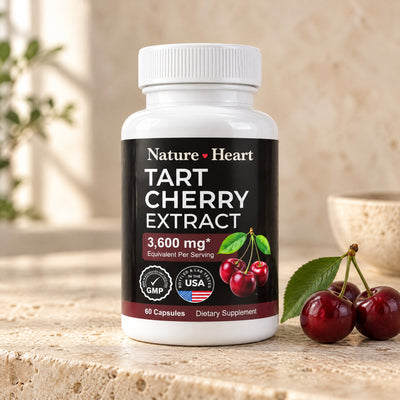
Nature Heart Cold-Pressed Tart Cherry Extract is made from Montmorency tart cherry that is cold-pressed, not heat-dried, and standardized for anthocyanins. Two capsules a day deliver 3,600 mg equivalent of tart cherry. The capsule is a two-piece vegetable hard capsule filled with cherry powder and nothing else: no fillers, flow agents, colors or additives.
Every batch is third-party lab tested before it ships, which is the part that makes "cold-pressed" and "standardized" mean something. In our October 2026 buyer survey, "cold pressed" was the single most mentioned reason people chose it, and several had switched from another tart cherry product that "didn't do anything." There is a 90-day money-back guarantee if it is not for you.
Frequently Asked Questions
What does cold-pressed mean for a tart cherry supplement?
It means the juice and pulp are pressed out of the fruit without cooking it, and the resulting material is concentrated and dried at low temperature instead of in a hot oven or dryer. The point is to keep the anthocyanins, the fragile red pigments, intact. The label should say cold-pressed or low-temperature and ideally state that the product is standardized for anthocyanins.
How much anthocyanin is lost when tart cherry is heated?
It depends on temperature and time. In one study, sour cherry juice held at 70 degrees Celsius for 4 hours lost about 18 to 19 percent of its anthocyanins, at 80 degrees about 29 percent, and at 90 degrees 38 to 46 percent. Freeze-drying, by contrast, reduced total polyphenols by only 1.5 to 5 percent in another study.
Is tart cherry juice concentrate heat-treated?
Most commercial juice concentrate is pasteurized and evaporated, which involves heat, though the exact process varies by producer. Concentrate still carries anthocyanins, and it is the form used in many of the sleep and recovery studies. If you want the least heat exposure, look for cold-pressed or freeze-dried products.
Does standardized for anthocyanins guarantee a good product?
It is a good sign, because it means the maker measures the pigments and holds each batch to a level. It is not a guarantee by itself. The NIH notes that words like standardized, verified or certified do not by themselves ensure quality. Look for third-party batch testing alongside the standardization claim.
Why does the color of tart cherry powder matter?
The anthocyanins are the color. A powder or capsule fill that has gone brown or dull has lost pigment, usually from heat or long storage. A fresh Montmorency powder is a reddish mauve. Color is a rough guide, not a test, but it is one you can check yourself.
Sources
- Szalóki-Dorkó L et al. (2015). Degradation of Anthocyanin Content in Sour Cherry Juice During Heat Treatment. Food Technology and Biotechnology 53(3). https://hrcak.srce.hr/en/145514
- Zorić Z et al. (2016). Impact of packaging material and storage conditions on polyphenol stability, colour and sensory characteristics of freeze-dried sour cherry (Prunus cerasus var. Marasca). J Food Sci Technol. PMID: 27162405. https://www.ncbi.nlm.nih.gov/pmc/articles/PMC4837736/
- Chaovanalikit A, Wrolstad RE (2004). Total Anthocyanins and Total Phenolics of Fresh and Processed Cherries and Their Antioxidant Properties. Journal of Food Science 69(1). https://doi.org/10.1111/j.1365-2621.2004.tb17858.x
- Kirakosyan A et al. (2009). Chemical profile and antioxidant capacities of tart cherry products. Food Chemistry 115(1). https://doi.org/10.1016/j.foodchem.2008.11.042
- Jäger R et al. (2025). Effects of Tart Cherry Extract Supplementation on Plasma Urate and C-Reactive Protein Levels in Healthy Adults. J Diet Suppl. PMID: 41247121. https://pubmed.ncbi.nlm.nih.gov/41247121/
- Levers K et al. (2015). Effects of powdered Montmorency tart cherry supplementation on an acute bout of intense lower body strength exercise in resistance trained males. J Int Soc Sports Nutr. PMID: 26578852. https://pmc.ncbi.nlm.nih.gov/articles/PMC4647629/
- NCCIH (NIH). Using Dietary Supplements Wisely. https://www.nccih.nih.gov/health/using-dietary-supplements-wisely
- Wojdyło A, Figiel A, Lech K, Nowicka P, Oszmiański J (2014). Effect of Convective and Vacuum-Microwave Drying on the Bioactive Compounds, Color, and Antioxidant Capacity of Sour Cherries. Food and Bioprocess Technology. https://doi.org/10.1007/s11947-013-1130-8
- Akcicek A et al. (2023). Influence of Different Drying Techniques on the Drying Kinetics, Total Bioactive Compounds, Anthocyanin Profile, Color, and Microstructural Properties of Blueberry Fruit. ACS Omega. PMID: 37970003. https://pmc.ncbi.nlm.nih.gov/articles/PMC10634226/
- Brownmiller C, Howard LR, Prior RL (2008). Processing and storage effects on monomeric anthocyanins, percent polymeric color, and antioxidant capacity of processed blueberry products. Journal of Food Science. PMID: 18576998. https://pubmed.ncbi.nlm.nih.gov/18576998/
- Ou B, Bosak KN, Brickner PR, Iezzoni DG, Seymour EM (2012). Processed tart cherry products, comparative phytochemical content, in vitro antioxidant capacity and in vitro anti-inflammatory activity. Journal of Food Science. PMID: 23163942. https://pubmed.ncbi.nlm.nih.gov/23163942/