How to Choose a Tart Cherry Supplement
By Amanda Bryne9 min read

To choose a tart cherry supplement, check seven things on the label: the cherry variety, how it was processed, whether it is standardized for anthocyanins, the real dose per serving, what else is in the capsule, whether batches are tested by an outside lab, and what happens if it does not work for you. A product that answers all seven clearly is worth your money. One that dodges three or more probably is not.
Tart cherry is a crowded shelf. Most products look alike, and the prices run from a few dollars to over fifty. The difference is rarely the cherry. It is what was done to it and how honest the label is about it.
This guide goes through each check in the order you would read a label, with the research behind why it matters.
Key studies at a glance
| Study | What was tested | Form and dose | How long | What the researchers found |
|---|---|---|---|---|
|
Levers et al. 2015, J Int Soc Sports Nutr PMID: 26578852 |
Recovery after heavy squats in 23 resistance-trained men | 480 mg a day of powdered Montmorency in capsules | 10 days | Less soreness and less strength loss than placebo |
|
Levers et al. 2016, J Int Soc Sports Nutr PMID: 27231439 |
A half-marathon in 27 endurance-trained runners and triathletes | 480 mg a day of powdered Montmorency in capsules vs rice flour placebo | 10 days | Cherry group finished about 13 % faster, with smaller rises in muscle-breakdown markers |
|
Jäger et al. 2025, J Diet Suppl PMID: 41247121 |
Uric acid and CRP in 10 healthy adults, crossover | 500 mg a day of a standardized tart cherry extract powder | 4 weeks | Plasma urate 37.4 % and CRP 23 % lower than placebo |
|
Tucker et al. 2024, Nutrients PMID: 39683518 |
Sleep and inflammation in 34 adults with overweight or obesity and sleep problems | 500 mg Montmorency powder capsules an hour before bed | 14 days | No effect on any sleep or inflammation measure; authors suggest testing higher doses |
|
Sabou et al. 2021, Frontiers in Nutrition PMID: 33842524 |
How 43 tart cherry supplement studies measured what was in the product | Review; anthocyanin doses ranged 15 to 547 mg a day | Studies ran from a single dose to 84 days | Only 20 of 43 analyzed their own supplement batch |
|
Crawford et al. 2022, JAMA Network Open PMID: 35947382 |
Label accuracy of 30 immune-support supplements bought online | Lab analysis by liquid chromatography-mass spectrometry | Products bought May 2021 | Only 13 of 30 labels were accurate; 13 listed ingredients that were not detected |
1. Variety: is it Montmorency?
Nearly all of the published research on tart cherry was done on one variety, Montmorency (Prunus cerasus). A label that says "cherry" with no species could be sweet cherry, a different fruit with a different chemistry. Look for "Montmorency" or at least "tart cherry (Prunus cerasus)". The Australian Institute of Sport, which grades sports supplements by evidence, lists cherries and other fruit polyphenols in its Group B and notes that evidence may only apply to the specific variety tested. If you want the background, read what Montmorency tart cherry is.
2. Processing: cold-pressed or heat-dried?
The compounds in tart cherry that the research points to are anthocyanins, the red pigments in the skin. They break down with heat. A 2015 study that held sour cherry juice at 70, 80 and 90 degrees Celsius for four hours measured anthocyanin losses of roughly 18 to 19 percent, 29 percent, and 38 to 46 percent at the three temperatures. Hotter and longer means less pigment in the finished powder.
So the label should say how the cherry was processed. "Cold-pressed," "freeze-dried" or "low-temperature" are the words you want. "Dried" or "powder" with no method usually means hot-air drying. If a brand will not say, assume heat. We cover the methods in detail in cold-pressed vs heat-dried tart cherry.
3. Standardized for anthocyanins
Standardized means the maker measures the anthocyanins and holds every batch to a stated level. Without it, two bottles from the same brand can differ, and you have no way to compare one product's dose to another's. The 2025 crossover trial that found plasma urate 37.4 percent lower and C-reactive protein 23 percent lower than placebo in 10 healthy adults used a standardized tart cherry extract, 500 mg a day for four weeks. The authors noted that processing and formulation can influence how stable and effective a tart cherry product is. Standardization is how you know what you are taking.
Researchers run into the same problem. A 2021 review of 43 tart cherry supplement studies found that only 20 had analyzed the batch they actually gave people. Seventeen borrowed figures from earlier papers, and six reported no polyphenol content at all. Across the studies, the anthocyanin dose ranged from 15 to 547 mg a day, so the authors could not say which dose works best and asked that every study batch be measured.
A caveat from the NIH's National Center for Complementary and Integrative Health: its supplement guide says the terms "standardized," "verified" and "certified" do not by themselves guarantee quality. The claim needs testing behind it, which is check number six.
4. The real dose per serving
This is where labels get slippery. A bottle might say "1,000 mg" in big type, but that could be 1,000 mg of a powder cut with a carrier, or 1,000 mg of a 10-to-1 concentrate, which are very different amounts of cherry. Look for two things: the serving size in capsules, and a fruit equivalent, meaning how much actual tart cherry the serving represents. "3,600 mg equivalent per serving" tells you more than "500 mg extract" with no ratio.
For scale, the human trials used a range. The Texas A&M study gave 23 resistance-trained men 480 mg a day of powdered Montmorency in capsules for 10 days and saw less soreness and less strength loss after a heavy squat session. The same lab then gave 27 endurance-trained runners and triathletes the same 480 mg capsule dose for 10 days around a half-marathon. The cherry group finished about 13 percent faster than the placebo group, though the groups were small (11 on cherry, 16 on placebo). The uric acid trial used 500 mg a day of a standardized extract. Sleep studies used juice concentrate or 240 mL of juice twice a day. Products differ in concentration, so follow the label of the one you choose, and be suspicious of any label that makes the math impossible.
Dose is not a detail. A 2024 Michigan State trial gave 34 adults with overweight or obesity and sleep problems 500 mg Montmorency powder capsules an hour before bed for 14 days. It found no effect on sleep or on inflammation markers, and the authors concluded that studies in this group should test higher doses.
Also count the days. Sixty capsules at two a day is 30 days. Thirty capsules at two a day is 15 days, which doubles the real monthly price.
5. What else is in the capsule
Turn the bottle around and read the "other ingredients" line. A tart cherry capsule needs two things: cherry and the capsule. Everything else is there for the manufacturer, not for you. Magnesium stearate and silicon dioxide are flow agents that help high-speed machines. Maltodextrin and rice flour are fillers that bulk out a small dose. Colors are there to make a faded powder look red. Gummies add sugar, pectin or gelatin, and flavors, and usually carry less cherry per piece.
None of these are dangerous. They just dilute the thing you are paying for and make the dose harder to judge. A short ingredient list is a sign that the maker is confident in the cherry. Capsule type matters a little too: a two-piece vegetable hard capsule holds dry powder with no need for oils or emulsifiers, which is why most one-ingredient products use it. Softgels need a liquid carrier. If you are weighing forms, see capsules vs juice vs gummies.
6. Third-party testing, every batch
US supplement makers are not required to prove a product works before selling it. The FDA regulates supplements under a separate framework from drugs: the company is responsible for making sure its product is safe and its label truthful, and the FDA acts after a product is on the market if it is adulterated or mislabeled. Manufacturing is covered by 21 CFR Part 111, the good manufacturing practice rules, which among other things require at least one test to verify the identity of each dietary ingredient before use.
That is the floor. Third-party testing goes above it: an independent lab, not the maker, analyzes the finished product for identity, potency and contaminants such as heavy metals and microbes. The phrase to look for is "every batch," not just "tested." A single test from two years ago says nothing about the bottle in your hand. If the label says third-party tested but not which lab or what for, email the brand and ask. A real answer takes one reply.
NCCIH also warns that labels do not always match contents, and that it has found undeclared drug ingredients in products sold as supplements. Batch testing is how a brand proves its label is true.
Independent testing bears this out. When researchers analyzed 30 immune-support supplements bought online in 2021, only 13 had accurate labels. Thirteen listed ingredients the lab could not detect, and nine contained substances that were not on the label. None were tart cherry products and 30 is a small sample, but it shows why "every batch tested" is worth looking for.
7. The guarantee, the price and the fine print
Tart cherry is not a fast-acting supplement. The strength study ran 10 days, the uric acid trial 4 weeks, and a 2026 meta-analysis of four randomized trials on uric acid, covering 392 people, found a modest average reduction with high variation between studies. In plain terms, some people respond more than others, and you need a few weeks to know which you are. A brand that believes in its product makes that easy: a money-back window long enough to actually run the test, 60 to 90 days, with no hoops.
On price, work out the cost per 30-day serving rather than per bottle, and check what a subscription actually commits you to. Monthly refill plans are convenient if you can cancel anytime; they are a trap if you cannot. Watch shipping too. A $4.99 charge on a single bottle is normal. A product that only ships free at $100 is quietly more expensive than it looks.
A quick checklist
If you want it on one line: Montmorency, cold-pressed, standardized for anthocyanins, a clear fruit equivalent per serving, no fillers, every batch third-party tested, and a real guarantee. Skip anything that fails more than two of those. And whatever you choose, tell your doctor or pharmacist, especially if you take blood thinners, uric acid medication or blood pressure medication. Tart cherry is a food, but supplements can interact with medicines, and your doctor should know what is in your cabinet.
Where Nature Heart fits
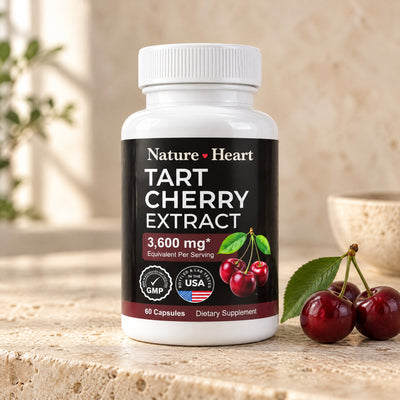
Nature Heart Cold-Pressed Tart Cherry Extract was built around this checklist. It is Montmorency tart cherry, cold-pressed and standardized for anthocyanins. Two capsules a day give 3,600 mg equivalent of tart cherry, 60 capsules per bottle, 30 days. The ingredient list is tart cherry and a two-piece vegetable hard capsule, nothing else. Every batch is third-party lab tested before it ships, and there is a 90-day money-back guarantee.
The current one-time offer is $31.99 for one bottle, with $4.99 US shipping below $47.99. Two bottles plus one free cost $47.99, and three bottles plus two free cost $63.99; both bundles ship free to the US. These purchases do not include a subscription or automatic refill. In our October 2026 buyer survey, the things people said convinced them were "cold pressed," "tested every batch," "one ingredient, no fillers" and the 90-day guarantee, which is the checklist above in their words.
Frequently Asked Questions
What should a good tart cherry supplement have on the label?
The variety (Montmorency or Prunus cerasus), the processing method (cold-pressed, freeze-dried or low-temperature), a statement that it is standardized for anthocyanins, a clear serving size with a fruit equivalent, a short ingredient list, and a note that batches are third-party tested. If more than one of those is missing, keep looking.
How much tart cherry should I take per day?
The studies used a range. A strength study used 480 mg a day of powdered Montmorency capsules for 10 days. A uric acid trial used 500 mg a day of a standardized extract for 4 weeks. Sleep studies used juice concentrate or 240 mL of juice twice a day. Follow the label of the product you choose, since products differ in concentration.
Are tart cherry gummies as good as capsules?
Gummies usually carry less cherry per piece and add sugar, pectin or gelatin, flavors and colors. A capsule can hold concentrated powder with nothing else. If you want a meaningful dose with one ingredient, capsules are the simpler choice. Our capsules vs juice vs gummies article compares the forms in detail.
What does third-party tested mean?
An independent laboratory, not the manufacturer, analyzes the finished product for identity, potency and contaminants. US rules already require makers to verify the identity of dietary ingredients, but outside testing of every batch goes further. Ask the brand which lab and what is tested if the label is vague.
Can I take tart cherry with my medications?
Tart cherry is a food, and the supplement studies were run in healthy adults. Supplements can still interact with medicines, so tell your doctor or pharmacist what you take, especially if you are on blood thinners, uric acid medication or anything for blood pressure.
What studies have been done on tart cherry capsules and doses?
Two Texas A&M trials gave 480 mg a day of powdered Montmorency in capsules for 10 days: 23 resistance-trained men had less soreness and strength loss, and 27 endurance athletes finished a half-marathon about 13 percent faster than placebo. A 4-week trial of 500 mg a day of a standardized extract in 10 healthy adults found urate 37.4 percent lower than placebo. A 2024 trial of 500 mg capsules for 14 days in 34 adults with overweight or obesity found no effect on sleep.
Sources
- NCCIH (NIH). Using Dietary Supplements Wisely. https://www.nccih.nih.gov/health/using-dietary-supplements-wisely
- US FDA. Dietary Supplements. https://www.fda.gov/food/dietary-supplements
- eCFR. 21 CFR Part 111, Current Good Manufacturing Practice in Manufacturing, Packaging, Labeling, or Holding Operations for Dietary Supplements. https://www.ecfr.gov/current/title-21/chapter-I/subchapter-B/part-111
- Levers K et al. (2015). Effects of powdered Montmorency tart cherry supplementation on an acute bout of intense lower body strength exercise in resistance trained males. J Int Soc Sports Nutr. PMID: 26578852. https://pmc.ncbi.nlm.nih.gov/articles/PMC4647629/
- Jäger R et al. (2025). Effects of Tart Cherry Extract Supplementation on Plasma Urate and C-Reactive Protein Levels in Healthy Adults. J Diet Suppl. PMID: 41247121. https://pubmed.ncbi.nlm.nih.gov/41247121/
- Zhang Z et al. (2026). Tart cherry intake and serum uric acid: Meta-analysis of randomized controlled trials. Asia Pacific Journal of Clinical Nutrition. PMID: 42242852. https://pmc.ncbi.nlm.nih.gov/articles/PMC13236459/
- Szalóki-Dorkó L et al. (2015). Degradation of Anthocyanin Content in Sour Cherry Juice During Heat Treatment. Food Technology and Biotechnology 53(3). https://hrcak.srce.hr/en/145514
- Australian Institute of Sport. Supplement Framework, Group B. https://www.ais.gov.au/nutrition/supplements/group_b
- Levers K et al. (2016). Effects of powdered Montmorency tart cherry supplementation on acute endurance exercise performance in aerobically trained individuals. J Int Soc Sports Nutr. PMID: 27231439. https://pmc.ncbi.nlm.nih.gov/articles/PMC4880859/
- Tucker RM et al. (2024). Commonly Used Dose of Montmorency Tart Cherry Powder Does Not Improve Sleep or Inflammation Outcomes in Individuals with Overweight or Obesity. Nutrients. PMID: 39683518. https://pmc.ncbi.nlm.nih.gov/articles/PMC11644614/
- Sabou VR, O'Leary MF, Liu Y, Brown PN, Murch S, Bowtell JL (2021). Review of Analytical Methods and Reporting of the Polyphenol Content of Tart Cherry Supplements in Human Supplementation Studies Investigating Health and Exercise Performance Effects: Recommendations for Good Practice. Frontiers in Nutrition. PMID: 33842524. https://pmc.ncbi.nlm.nih.gov/articles/PMC8032894/
- Crawford C et al. (2022). Analysis of Select Dietary Supplement Products Marketed to Support or Boost the Immune System. JAMA Network Open. PMID: 35947382. https://pmc.ncbi.nlm.nih.gov/articles/PMC9366544/