Tart Cherry Capsules vs Juice vs Gummies: Which Form Fits You
By Amanda Bryne10 min read
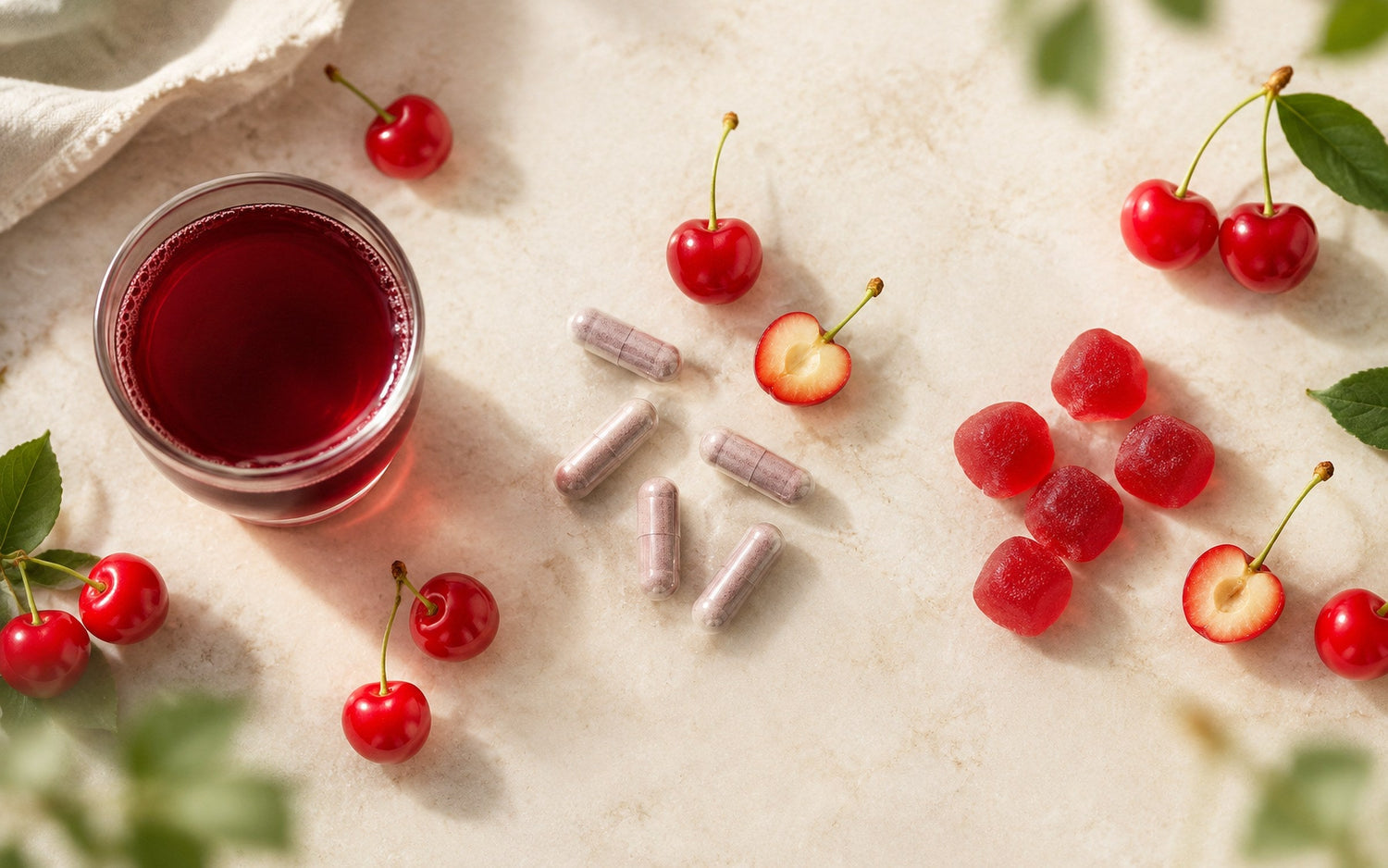
Tart cherry comes in three common forms: capsules, juice (usually a concentrate you dilute), and gummies. The research was done with two of them. In a 2026 scoping review of 28 trials on Montmorency tart cherry, 19 used juice or concentrate and nine used capsules or tablets of cherry powder. None used gummies.
So the honest short answer is this. Juice and powder capsules both have trials behind them. Capsules give you the cherry without the sugar, the fridge, or the glass before bed. Juice gives you the exact form most of the older studies used, along with the fruit's sugar. Gummies are the easiest to eat and the hardest to defend with evidence.
The rest of this guide goes through what each form actually delivers, what it costs you day to day, and how to compare them on a label.
Key studies at a glance
| Study | What was tested | Form and dose | How long | What the researchers found |
|---|---|---|---|---|
|
Zhu et al. 2026, Frontiers in Nutrition PMID: 42146083 |
28 randomized trials on Montmorency in healthy adults | 19 used juice or concentrate, 9 capsules or tablets of powder, none gummies | 1 to 19 days per trial | 7 of 14 strength studies found faster strength recovery; 4 of 10 found better performance |
|
Levers et al. 2016, J Int Soc Sports Nutr PMID: 27231439 |
A half-marathon in 27 endurance-trained runners and triathletes | 480 mg a day of powdered Montmorency in capsules | 10 days | Cherry group finished about 13 % faster than placebo |
|
Howatson et al. 2012, European Journal of Nutrition PMID: 22038497 |
Sleep in 20 healthy adults, crossover | Tart cherry juice concentrate vs placebo | 7 days | More total sleep, better sleep efficiency and higher melatonin in the urine |
|
Jäger et al. 2025, J Diet Suppl PMID: 41247121 |
Uric acid and CRP in 10 healthy adults, crossover | 500 mg a day of a standardized tart cherry extract powder | 4 weeks | Plasma urate 37.4 % and CRP 23 % lower than placebo |
|
Gao et al. 2024, PLoS One PMID: 39141644 |
Cycling and recovery in 12 recreational cyclists, juice vs sports drink | Tart cherry juice, 150 mL twice a day; each dose 101 kcal and 13 g sugars | 4 days before and 2 days after exercise | No difference from the sports drink in performance or recovery |
|
Keane et al. 2016, European Journal of Nutrition PMID: 26163338 |
What reaches the blood in 12 healthy men | One dose of 30 or 60 mL Montmorency concentrate | Blood taken over 8 hours | Two cherry phenolic acids peaked in blood 1 to 2 hours after, with traces at 8 hours |
What the research actually used
It helps to start with what the trials did, because that is the only solid ground here.
The 2026 scoping review in Frontiers in Nutrition looked at 28 randomized trials on Montmorency tart cherry in healthy adults, mostly young and active. Seven of 14 strength-recovery studies found faster recovery of muscle strength after hard exercise. Four of 10 performance studies found better performance. Six of 22 found less soreness. The review calls the recovery findings "preliminary support" and the rest mixed. That is the fair summary.
Now the forms. Nineteen of those 28 trials used juice or juice concentrate. Nine used capsules or tablets filled with freeze-dried Montmorency powder. One of the cleanest capsule trials is Levers and colleagues, 2015: 23 resistance-trained men took 480 mg of powdered Montmorency tart cherry in capsules once a day for 10 days around a heavy back-squat session. The cherry group reported less quadriceps soreness and lost less strength in the two days after the workout than the placebo group.
The same Texas A&M team then ran the capsule design on 27 endurance-trained runners and triathletes: 480 mg of powdered Montmorency a day for 10 days around a half-marathon. The cherry group finished about 13 percent faster than the placebo group and showed smaller rises in markers of muscle breakdown. The groups were small, 11 on cherry and 16 on placebo, so treat it as one encouraging trial, not a settled answer.
The sleep research leaned on juice. Howatson and colleagues, 2012 gave 20 healthy adults tart cherry juice concentrate for seven days and measured more time in bed, more total sleep and better sleep efficiency than placebo, along with higher melatonin in the urine. Losso and colleagues, 2018 gave adults over 50 with insomnia 240 mL of juice twice a day for two weeks; the eight who completed slept 84 minutes longer on sleep-lab measurement.
The uric acid work used extract in capsules. Jäger and colleagues, 2025 gave 10 healthy adults 500 mg of a standardized tart cherry extract daily for four weeks, placebo-controlled and crossover. Urate (uric acid in the blood) fell 37.4 percent and CRP, a general inflammation marker, fell 23 percent compared with placebo. Ten people is a small trial, but it tells you the capsule form is not a watered-down afterthought.
What about absorption? In a 2016 Northumbria University study, 12 healthy men drank a single 30 or 60 mL dose of Montmorency concentrate and gave blood samples over 8 hours. Two phenolic acids from the cherry showed up in the blood, peaking 1 to 2 hours after the drink, with traces still there at 8 hours. That study used juice concentrate. We did not find a comparable absorption study on tart cherry capsules or gummies, so how the forms compare once swallowed is still an open question.
Capsules: what you get and what to check
A tart cherry capsule is the fruit, dried and ground, in a shell. The good ones are nothing else. Two capsules a day is a typical serving and a 60-count bottle lasts a month.
What capsules do well: no sugar, no calories to speak of, no taste, nothing to measure, nothing that needs a fridge. They travel. You can take them at night without a glass of liquid before bed, which matters for anyone who already gets up to use the bathroom.
What to check on the label, in order:
- Variety. Montmorency is the variety in almost all the research. If the bottle just says "tart cherry" or "cherry fruit", you do not know what is in it.
- How it was dried. Heat is the enemy of anthocyanins, the red pigments the research is interested in. In a 2015 study on sour cherry juice, four hours at 90 °C destroyed 38 to 46 percent of the anthocyanins, depending on the cultivar. Cold-pressed or freeze-dried powder avoids that. We cover this in cold-pressed vs heat-dried tart cherry.
- Fruit equivalent per serving. A capsule holds a few hundred milligrams of powder, but that powder stands in for a lot more fruit. Makers who know their concentration ratio state it as "mg equivalent" of whole cherry. Makers who do not state it leave you guessing.
- Standardization. "Standardized for anthocyanins" means the maker tests each batch for the pigment content rather than hoping. It is the single most useful phrase on a tart cherry label.
- The other ingredients line. Flow agents like magnesium stearate and silica, rice flour fillers, colors. None of them hurt you. All of them take up room that could be cherry.
The weak point of capsules is that a bad one is easy to make and hard to spot. A 500 mg capsule of heat-dried, unstandardized powder looks exactly like a 500 mg capsule of cold-pressed, standardized powder. The label is the only tell.
Juice and concentrate: the original form
Tart cherry juice concentrate is what the sleep trials and most of the recovery trials used. If you want to copy a study as closely as possible, this is the form.
What juice does well: it is the whole pressed fruit, nothing removed except water. The dose is big by nature; a shot of concentrate stands in for a large handful of cherries. It is easy to find in grocery stores. And some people simply like it.
What it costs you: sugar and calories come with the fruit, and the concentrate is sweet. If you are watching blood sugar, watching weight, or taking it twice a day as the sleep trials did, that adds up. It needs a fridge once opened. It stains. It is awkward to travel with. And it is a drink before bed, which is the time many people least want a drink.
To put a number on the sugar: a 2024 University of Saskatchewan trial listed its tart cherry juice at 101 calories and 13 grams of sugars per 150 mL dose, taken twice a day, so about 26 grams of sugars a day from the juice alone. In that trial, 12 recreational cyclists did no better on the juice than on a sports drink, for performance or recovery. Juice products vary, so check the label of the one you buy.
There is also a processing question nobody puts on the front of the bottle. Most shelf-stable juice is pasteurized, which means heat. Heat degrades anthocyanins, as the study above shows. The pasteurization step is shorter than four hours, so the loss is smaller, but it is not zero, and a concentrate that was heated to evaporate the water has been through heat twice. Cold-pressed, unheated juice exists but is rare and expensive.
Comparing juice to capsules on a label is hard because juice is sold by volume and capsules by weight. The only clean comparison is the anthocyanin figure, where a maker gives one.
Gummies: convenient, and that is most of it
Gummies are the newest form and the one with the least behind it. In the scoping review above, not one of the 28 trials used a gummy. We could not find a published human trial that did.
That does not mean a gummy cannot contain tart cherry. It means nobody has tested whether the amount in a gummy does what the juice and capsule doses did. And the amount is the issue. A gummy is mostly sugar or sugar alcohol, pectin or gelatin, flavor, and color, with a small amount of cherry powder or concentrate pressed into the space that is left. To reach the cherry equivalent of two capsules you would often need a handful of gummies, and with them a handful of sugar.
Gummies also tend to be heat-processed by nature, because the base is cooked. That brings back the anthocyanin problem.
If chewing a gummy is the only way you will remember to take anything, a gummy is better than a bottle of capsules that sits unopened. Just read the serving size, read the sugar line, and do not expect it to match the research.
The side-by-side
Here is how the three forms compare on the points that matter to most buyers.
- Evidence. Juice: most trials. Capsules: nine of 28 recovery trials, plus the uric acid extract trial. Gummies: none found.
- Sugar. Juice: comes with the fruit, and concentrate is sweet. Capsules: none. Gummies: added sugar is usually the first ingredient.
- Heat exposure. Juice: usually pasteurized, concentrate often heated twice. Capsules: depends entirely on how the powder was dried, so check. Gummies: cooked base.
- Daily effort. Juice: pour, dilute, refrigerate, repeat twice a day. Capsules: two with water. Gummies: chew.
- Travel and storage. Juice: fridge after opening. Capsules: anywhere. Gummies: melt in a hot car.
- Cost per day. Work it out yourself, because bottle prices mislead. A 30-day capsule bottle divided by 30 is the number to compare against a bottle of concentrate divided by the number of servings on its label.
How to decide
Pick by the problem you are solving, then by the routine you will keep.
If you want to copy the sleep trials exactly, juice concentrate twice a day is what they used. If you want the same daily cherry intake without a glass of sweet liquid at night, capsules are the practical version. If your reason is joint comfort or uric acid, the extract and powder trials used capsules, so capsules are the natural fit. If you are recovering from training, both juice and powder capsules have trials in their favor.
Then be honest about the routine. Tart cherry is a daily thing in every study that found an effect. Seven days, ten days, four weeks. The form that you will actually take every day for a month beats the form that looks best on paper. For most adults over 45, that is the one with no sugar, no fridge and no prep.
Our guide to choosing a tart cherry supplement goes through the label checks in more depth.
Where Nature Heart fits
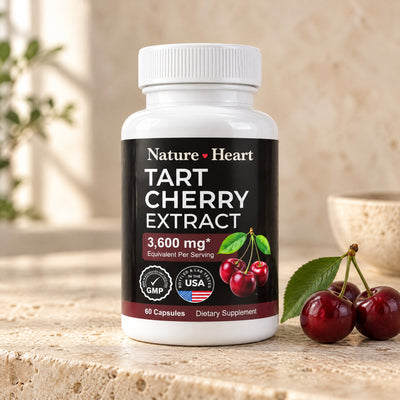
Nature Heart makes one product, and it is a capsule: Nature Heart Cold-Pressed Tart Cherry Extract. Two vegetable capsules a day give 3,600 mg equivalent of Montmorency tart cherry per serving, cold-pressed rather than heat-dried and standardized for anthocyanins. Tart cherry and the capsule are the only ingredients. No fillers, flow agents or colors. Every batch is third-party lab tested before it ships, and there is a 90-day money-back guarantee.
We chose capsules because they solve the three complaints we hear most about juice and gummies: the sugar, the fridge, and the drink before bed. If you would rather have juice, that is a fair choice too, and the sleep research is on your side. Whatever form you pick, read the label the way this guide describes and take it every day.
Frequently Asked Questions
Is tart cherry juice better than capsules?
Not by default. Most published trials used juice or concentrate, but nine of the 28 trials in a 2026 scoping review used powdered Montmorency capsules or tablets, and those produced some of the clearest strength-recovery results. Juice carries the fruit's sugar and calories with it. Capsules carry the fruit without the sugar. The better form is the one you will take every day.
Do tart cherry gummies work?
We could not find a published human trial that used tart cherry gummies. Gummies usually hold a small amount of cherry per piece plus sugar, pectin or gelatin and flavor. If you want to copy what the research did, juice concentrate or powder capsules are the forms with evidence behind them.
How much tart cherry juice equals a capsule serving?
It depends on the product, which is the problem. Juice labels list fluid ounces, capsule labels list milligrams of powder or extract, and neither tells you the anthocyanin content unless the maker standardizes for it. Compare the anthocyanin figure where it is given, and compare the fruit equivalent per serving where it is not.
Can I take tart cherry capsules instead of drinking the juice before bed?
Yes, many people do, since capsules have no sugar and no volume to drink late at night. The sleep trials themselves used juice taken twice a day, so a capsule routine is a reasonable copy of the daily intake, not an exact copy of the study.
Which form is cheapest per day?
Juice concentrate is often the cheapest per bottle but you drink through it fast, and it needs a fridge once opened. Capsules cost more per bottle but a 60-capsule bottle lasts 30 days with no prep. Work out the cost per day, not per bottle.
What studies have been done on tart cherry capsules vs juice?
A 2026 scoping review counted 28 trials on Montmorency tart cherry: 19 used juice or concentrate and 9 used capsules or tablets of powder. In one capsule trial, 27 endurance athletes took 480 mg a day for 10 days and finished a half-marathon about 13 percent faster than placebo. In a 2024 juice trial, each 150 mL dose carried 13 grams of sugars and was taken twice a day. No published trial we found used gummies.
Sources
- Zhu Y, Smith J, Cohn A (2026). The effect of Montmorency tart cherry consumption on athletic performance and post-exercise recovery in healthy adults: a scoping review. Frontiers in Nutrition. PMID: 42146083. https://pmc.ncbi.nlm.nih.gov/articles/PMC13173514/
- Levers K et al. (2015). Effects of powdered Montmorency tart cherry supplementation on an acute bout of intense lower body strength exercise in resistance trained males. Journal of the International Society of Sports Nutrition. PMID: 26578852. https://pubmed.ncbi.nlm.nih.gov/26578852/
- Howatson G et al. (2012). Effect of tart cherry juice (Prunus cerasus) on melatonin levels and enhanced sleep quality. European Journal of Nutrition. PMID: 22038497. https://pubmed.ncbi.nlm.nih.gov/22038497/
- Losso JN et al. (2018). Pilot Study of the Tart Cherry Juice for the Treatment of Insomnia and Investigation of Mechanisms. American Journal of Therapeutics. PMID: 28901958. https://pubmed.ncbi.nlm.nih.gov/28901958/
- Jäger R, Purpura M, Balcombe ST, Godavarthi A, Reddy SA, Vasenina E, Tinsley GM (2025). Effects of Tart Cherry Extract Supplementation on Plasma Urate and C-Reactive Protein Levels in Healthy Adults: a Randomized Controlled Trial. Journal of Dietary Supplements. PMID: 41247121. https://www.tandfonline.com/doi/full/10.1080/19390211.2025.2589787
- Szalóki-Dorkó L et al. (2015). Degradation of Anthocyanin Content in Sour Cherry Juice During Heat Treatment. Food Technology and Biotechnology. PMID: 27904369. https://pmc.ncbi.nlm.nih.gov/articles/PMC5068385/
- Levers K et al. (2016). Effects of powdered Montmorency tart cherry supplementation on acute endurance exercise performance in aerobically trained individuals. Journal of the International Society of Sports Nutrition. PMID: 27231439. https://pmc.ncbi.nlm.nih.gov/articles/PMC4880859/
- Gao R, Rapin N, Andrushko JW, Farthing JP, Gordon J, Chilibeck PD (2024). The effect of tart cherry juice compared to a sports drink on cycling exercise performance, substrate metabolism, and recovery. PLoS One. PMID: 39141644. https://pmc.ncbi.nlm.nih.gov/articles/PMC11324131/
- Keane KM et al. (2016). Phytochemical uptake following human consumption of Montmorency tart cherry (L. Prunus cerasus) and influence of phenolic acids on vascular smooth muscle cells in vitro. European Journal of Nutrition. PMID: 26163338. https://pubmed.ncbi.nlm.nih.gov/26163338/